
Compounding Wealth: The Power of Interest and Dividends
Introduction to the Power of Compounding Interest
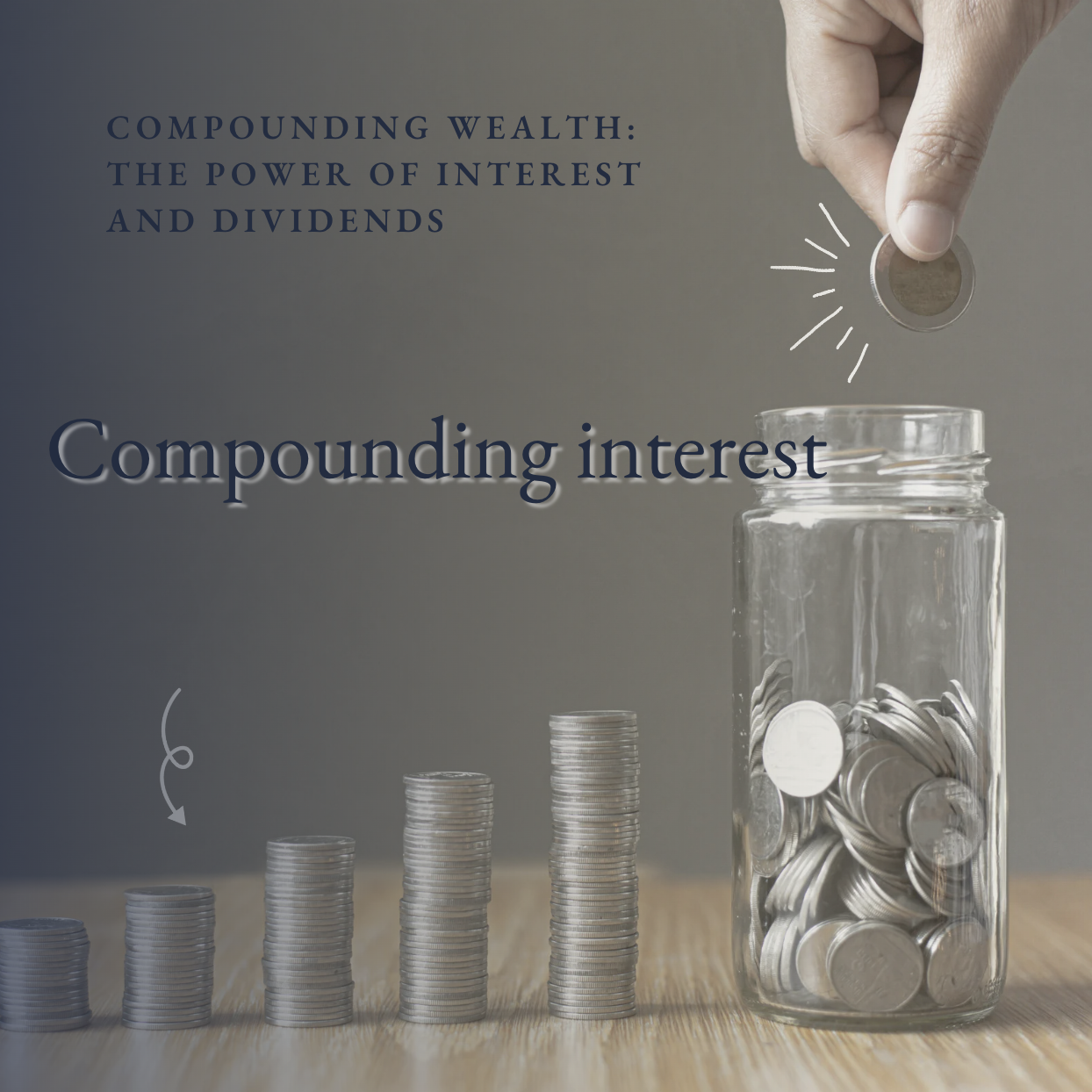
The power of compounding interest is a remarkable phenomenon that displays how tiny investments or savings can accumulate to large sums over time. Compound interest is the interest earned on both the initial principal amount and the accumulated interest from prior periods. This compounding effect results in an exponential increase in the value of an investment or savings account.
The concept of time is essential for comprehending the power of compounding interest. The longer an investment sits idle, the more time it has to compound, resulting in higher returns. This is frequently demonstrated by the Rule of 72, a simple formula used to determine how long it takes an investment to double in value. By dividing 72 by the yearly interest rate, one can estimate how many years it will take for an investment to double.
For example, take an investment with an annual interest rate of 8%. Using the Rule of 72, we can estimate that the investment will double in about 9 years (72 / 8 = 9). After 9 years, not only has the initial principal doubled, but the cumulative interest has also helped to grow the investment.
Compounding interest is especially powerful over lengthy periods of time. Even tiny, consistent payments to an investing or savings account can result in enormous wealth accumulation over several decades. This is why financial advisors frequently emphasize the necessity of starting to save and invest early in order to fully benefit from the compounding effect.
To maximize the benefits of compounding interest, it is critical to:
Start early: The earlier you start investing or saving, the longer your money has to compound.
Maintain consistency: Regular contributions or deposits to your investment or savings account serve to fuel the compounding process.
Reinvest returns: Rather than withdrawing interest earnings, reinvest them to ensure continued growth and compounding.
Overall, the power of compounding interest demonstrates the enormous potential for long-term wealth building and financial security through disciplined saving and investment. Individuals can attain their financial goals and create a better future for themselves and their families by taking advantage of the compounding impact.
Understanding Compounding
Compounding is like planting a seed and watching it grow into a mighty tree over time. It’s all about the snowball effect – small gains building upon each other, gradually accelerating to create significant outcomes. Think of it as a continuous cycle of growth and reinvestment, where your initial efforts multiply themselves over and over again.
Albert Einstein also used to say:
Compounding Interest is the Eighth Wonder of the World. He who understands it, earns it; he who doesn’t pays it.
1. Exponential Growth: Compounding causes your money to expand exponentially rather than linearly. When your investment generates interest, the profits are added to the principal, and future interest computations are based on the bigger amount. Over time, the compounding impact intensifies, resulting in enormous growth.
2. Time: Time is an important aspect in compounding. The longer your money is invested, the more opportunities it has for compounding. Because of the compounding impact, even little contributions can add up to large sums over time.
3. Snowball Effect: Compounding produces a snowball effect, in which your money gradually grows larger and greater without any additional effort on your side. This implies that your investment might grow significantly over time, often exceeding the amount you initially invested.
4. Reinvestment: To maximize the potential of compounding, reinvest the earnings from your investment. By reinvesting dividends, interest, or capital gains, your investment can compound on a bigger scale, resulting in even higher growth over time.
5. Consistency: Regularly adding to your investing portfolio can boost the power of compounding. Regular contributions increase the principal amount, increasing the opportunity for compounding to work its magic.
6. Risk Management: Compounding can assist reduce long-term investment risk. Even during periods of market volatility or downturns, the compounding effect can help level out swings and create favorable long-term returns.
In essence, the power of compounding interest is about patience, discipline, and knowing that tiny, consistent investments today can lead to considerable wealth creation later. It is a key notion in finance and investment that can assist individuals in meeting their long-term financial objectives.
“Comparing Simple and Compound Interest: Understanding Their Impact on Financial Growth”
1. Simple Interest:
Simple interest is a way of calculating interest on a loan or investment that just considers the initial principal amount. In other words, it is calculated by multiplying the principal amount by the interest rate and the time period during which the funds are borrowed or invested. The interest earned or paid is fixed for each period and does not include any interest that may accumulate over time. This simplifies interest calculations, particularly for short-term loans or investments.
· Growth Pattern: Simple interest produces linear growth, which means that the amount of interest earned is constant each period while the overall amount grows at a consistent rate.
2. Compound interest:
Compound interest is a method of calculating interest in which interest is added to the principal amount, and subsequent interest calculations are based on the larger principal. In essence, it is compound interest. Unlike simple interest, which is computed exclusively on the initial principal, compound interest considers both the principal and any interest earned over time. This leads to exponential growth over time, as interest earned or charged accelerated owing to compounding effects. Compound interest is widely employed in long-term investments, savings accounts, and loans because it mirrors the real-world scenario in which interest compounded over time.
· Growth Pattern: Compound interest produces exponential growth, which means that the total amount grows at a faster pace over time due to the compounding effect.
Comparison:
· Impact: Compound interest often results in bigger returns or debt accumulation than simple interest since it allows for the reinvestment of earned interest, which leads to faster growth.
· Time: Because of the compounding effect, compound interest is more beneficial over longer periods of time than simple interest, which remains constant regardless of duration.
· Applications: Compound interest is widely employed in long-term investments such as retirement and savings accounts, whereas simple interest may be utilized for short-term loans or investments.
In essence, compound interest has the potential to cause larger debt development or accumulation over time than simple interest due to its compounding effect. Understanding the distinctions between the two can help people make more educated financial decisions.
“Unlocking Financial Growth: Why Compound Interest Outperforms Simple Interest”
1. Growth Pattern:
· Compound Interest: With compound interest, the interest earned is reinvested back into the principal, leading to exponential growth over time. As a result, the total amount grows at an increasing rate, reflecting the compounding effect.
· Simple Interest: In contrast, simple interest results in linear growth, where the amount of interest earned remains constant over the investment period. The total amount grows at a steady rate without any compounding effect.
2. Calculation Method:
· Compound Interest: Interest is calculated not only on the initial principal amount but also on any interest accumulated over previous periods. This allows for the reinvestment of earned interest, leading to exponential growth.
· Simple Interest: Interest is calculated solely based on the initial principal amount throughout the investment period, without considering any accumulated interest. As a result, the interest earned remains constant.
3. Impact of Time:
· Compound Interest: The longer the investment is held, the more pronounced the compounding effect becomes, leading to significantly higher returns over time. Compound interest recognizes the time value of money and rewards investors for allowing their investments to grow over extended periods.
· Simple Interest: Simple interest does not recognize the time value of money to the same extent as compound interest. The growth of the investment remains linear and does not accelerate over time.
4. Returns on Investment:
· Compound Interest: Compound interest offers the potential for higher returns on investment compared to simple interest. The compounding effect allows for the exponential growth of the investment, resulting in greater wealth accumulation over time.
· Simple Interest: Simple interest may provide lower returns compared to compound interest, especially over longer investment periods. The linear growth pattern limits the total amount accumulated over time.
5. Long-Term Financial Goals:
· Compound Interest: Compound interest is particularly advantageous for achieving long-term financial goals, such as retirement savings or wealth accumulation. By starting to invest early and allowing investments to compound over several decades, individuals can build substantial wealth over time.
· Simple Interest: While simple interest may be suitable for short-term investments or loans, it may not be as effective for long-term financial planning due to its limited growth potential.
Conclusion:
Compound interest offers several advantages over simple interest, including exponential growth, recognition of the time value of money, higher returns on investment, and suitability for long-term financial goals. By understanding the differences between compound interest and simple interest, investors can make informed decisions to maximize their wealth accumulation and achieve their financial objectives more effectively.
“The Compounding Phenomenon: How Time and Interest Multiply Your Wealth”
1. Exponential Growth: At the heart of compounding is the idea of exponential growth. Each time interest is added to the principal, it becomes part of the new base for future interest calculations. This causes a compounding effect in which an investment’s growth accelerates over time, resulting in a steeper curve with each compounding period.
2. The Time Factor: Time plays an important role in the compounding equation. The longer money is allowed to grow, the more substantial the compounding effect grows. This is commonly referred to as the “miracle of compound interest.” Starting to save and invest early leverages the power of time, allowing even little contributions to develop into significant sums over time.
3. Compounding Frequency: Compounding might take place on an annual, semi-annual, quarterly, monthly, or even daily basis. The frequency of compounding has a significant impact on an investment’s overall growth. More frequent compounding causes faster growth since interest is earned and added to the principal more frequently.
4. The Effect of Interest Rate: The rate of return on an investment or the interest rate on a loan has a substantial impact on the power of compounding. Higher interest rates or rates of return intensify the effects of compounding, resulting in faster growth or increased debt. Lower interest rates, on the other hand, may reduce the compounding effect while still contributing to long-term growth.
5. Compounding Across Asset Classes: The benefits of compounding extend beyond typical savings accounts and investments. It applies to a variety of asset classes, including equities, bonds, mutual funds, real estate, and retirement savings. Each asset class has its own compounding characteristics and growth potential, allowing investors to diversify their portfolios while maximizing long-term gains.
6. Reinvestment of Earnings: Compounding is boosted when earnings from an investment, such as dividends, interest payments, or capital gains, are reinvested rather than withdrawn. Reinvesting earnings permits the investment to grow exponentially over time, as the basis for future interest or returns expands.
7. Impact on Wealth Accumulation: The power of compounding can turn even small savings into significant wealth over time. It encourages people to put long-term financial goals ahead of short-term gratification by rewarding disciplined saving and investment practices. Individuals who continuously contribute to investments and allow time and compounding to work their magic can accumulate enormous wealth and achieve financial freedom.
In essence, compounding is a powerful force that rewards patience, consistency, and long-term thinking. Understanding its mechanisms enables people to make informed decisions about saving, investing, and managing their money for long-term prosperity. Individuals can create a secure and prosperous financial future by leveraging the power of compounding.
“Understanding Dividends: Rewarding Shareholders and Fueling Investment Growth”
In finance, a dividend refers to a distribution of a portion of a company’s earnings to its shareholders. It’s essentially a reward that a company pays out to its shareholders for investing in the company’s stock. Dividends are typically paid in cash, but they can also be issued as additional shares of stock or other forms of property.
Companies that are profitable and have surplus earnings often choose to pay dividends to their shareholders as a way to share the company’s success and reward investors for their ownership. Dividends are usually paid on a regular basis, such as quarterly or annually, although some companies may pay them irregularly or not at all.
Investors who receive dividends from their investments can use them as additional income, reinvest them to purchase more shares of the company’s stock, or use them for other financial purposes.
Overall, dividends play an important role in attracting investors to stocks and are a key component of total return for shareholders. They can provide a steady stream of income and contribute to the overall growth of an investment portfolio.
“Diving into Dividends: Understanding How Dividend Payments Function in Finance”
1. Profit Distribution: When a company earns profits, it has several options for using those profits. One common option is to distribute a portion of the profits to its shareholders as dividends.
2. Decision by the Board: The decision to pay dividends is typically made by the company’s board of directors. They consider various factors such as the company’s financial health, cash flow, growth opportunities, and shareholder expectations.
3. Announcement: Once the decision is made, the company announces the dividend amount, the ex-dividend date (the date when the stock trades without the dividend), the record date (the date on which shareholders must be on record to receive the dividend), and the payment date.
4. Payment: On the payment date, the company distributes the dividend to its shareholders. Dividends are usually paid in cash, but they can also be paid in the form of additional shares of stock or other property.
5. Impact on Stock Price: The announcement and payment of dividends can have an impact on the company’s stock price. Investors often view dividends positively, as they indicate the company’s financial strength and commitment to shareholders. Consequently, the stock price may increase in anticipation of dividends and decrease after the ex-dividend date when the stock trades without the dividend.
6. Reinvestment or Income: Shareholders have the option to reinvest dividends to purchase more shares of the company’s stock, which can help compound their investment over time. Alternatively, they can use dividends as additional income to meet financial needs or invest in other opportunities.
Overall, dividends serve as a way for companies to share their profits with shareholders, reward them for their investment, and potentially attract more investors to their stock. They play a crucial role in the total return on investment and can contribute significantly to building wealth over the long term.
“Maximizing Returns: The Power of Dividends and Compound Interest Working Together”
Dividends and compound interest functioning together can be defined as the process by which dividends produced from investments are reinvested back into the same investment, raising the main amount used to compute compound interest. This method causes the investment to expand more quickly over time due to the compounding effect, resulting in significant long-term wealth accumulation.
1. Reinvestment of Dividends: When investors receive dividends from their investments, they have the option to reinvest those dividends back into the same investment. By doing so, they increase the principal amount on which compound interest is calculated.
2. Accelerated Growth: Reinvesting dividends leads to accelerated growth of the investment over time. As the reinvested dividends generate additional shares or increase the principal amount, compound interest is earned on a larger base, leading to faster growth.
3. Compounding Effect: The combination of reinvested dividends and compound interest creates a compounding effect, where the investment grows exponentially over time. This can significantly increase the total return on investment compared to just relying on the initial principal and simple interest.
4. Long-Term Wealth Building: By consistently reinvesting dividends and allowing compound interest to work its magic over the long term, investors can build substantial wealth. This strategy is particularly effective for retirement planning or achieving long-term financial goals.
5. Risk Mitigation: Dividend-paying stocks tend to be more stable and less volatile compared to non-dividend-paying stocks. Companies that pay dividends typically have strong cash flows and stable earnings, which can provide downside protection during market downturns. Dividends can serve as a source of income for investors, regardless of market conditions, helping to mitigate investment risk.
6. Income Stream: Dividends provide investors with a reliable source of income, especially in retirement or during periods of economic uncertainty. For income-oriented investors, dividend-paying stocks can supplement other sources of income, such as pensions or Social Security benefits. Dividends can also be used to cover living expenses or reinvested to further enhance investment returns.
7. Shareholder Alignment: Dividend payments demonstrate a company’s commitment to returning value to its shareholders. By paying dividends, companies signal confidence in their financial strength and ability to generate consistent profits. Dividend payments also align the interests of management and shareholders, as both parties benefit from the company’s success and profitability.
8. Diversification: Investors can diversify their portfolio by investing in dividend-paying stocks or funds that reinvest dividends automatically. This diversification can further enhance the potential for compound growth while providing a steady stream of income through dividends.
In summary, dividends and compound interest can work synergistically to boost investment returns and accelerate wealth accumulation. By reinvesting dividends and allowing compound interest to work over time, investors can harness the power of compounding to achieve their financial objectives.
Conclusion
In conclusion, the concepts of compound interest and dividends play pivotal roles in the realm of finance, offering pathways to long-term wealth accumulation and financial prosperity.
Compound interest stands as a cornerstone principle, representing the exponential growth potential inherent in disciplined saving and investing practices. Through its compounding effect, even modest contributions can burgeon into substantial sums over time. By understanding and leveraging compound interest, individuals can strategically plan for their financial futures, whether aiming for retirement security or achieving other long-term goals.
Dividends, on the other hand, serve as tangible rewards for investors, reflecting a company’s success and commitment to shareholder value. Reinvesting dividends back into investments further enhances the compounding effect, accelerating wealth growth and offering a reliable income stream. Additionally, dividends contribute to portfolio diversification and risk mitigation, bolstering financial resilience and stability.
When combined, dividends and compound interest form a formidable duo, working synergistically to maximize investment returns and propel wealth accumulation. By reinvesting dividends and allowing compound interest to work its magic over time, investors can unlock the full potential of their financial assets, achieving their aspirations and securing a prosperous future.
In essence, understanding and harnessing the synergy of dividends and compound interest is essential for individuals seeking to navigate the complexities of the financial landscape and build lasting prosperity. Through prudent financial management and strategic investment decisions, individuals can pave the way for a brighter financial future and unlock the doors to enduring wealth and abundance.